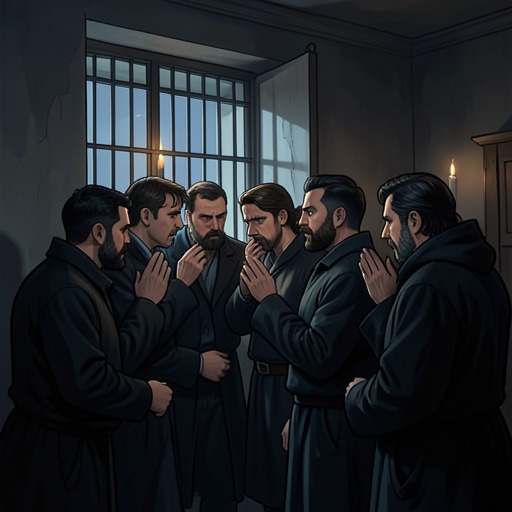
Mary refuses to renounce her legitimacy
The King's CursePrincess Mary Tudor’s refusal to renounce her legitimacy is a defining act of resistance to Henry VIII’s effort to make royal declaration determine both family status and the succession. Ordered to accept the name Lady Mary Tudor and the status of a bastard, she says she will obey her father’s commands but cannot give up rights that belong to her by birth. Her answer is restrained rather than openly rebellious, yet it refuses the essential demand: that she deny she is a Tudor princess.
The disputed basis of her status
The dispute rests on the validity of Henry VIII’s marriage to Katherine of Aragon, and on whether Katherine’s first marriage to Prince Arthur had been consummated. In an earlier confrontation, Margaret Pole is accused of conspiring with Katherine and her Spanish duenna to undermine the Tudor succession. Margaret is pressed to confirm that Prince Arthur was taken to Katherine’s room every week, as ordered. She acknowledges the visits, but that fact alone does not establish what happened between them. The distinction matters: the testimony under pressure concerns access to a room, while the political and religious argument turns on whether the marriage was consummated.
The stakes of that uncertainty are made explicit when Margaret is told that Henry VIII could seek a papal dispensation to marry Katherine if she continued to maintain that her marriage to Prince Arthur had never been consummated. Margaret is accused of supporting a lie that would plunge Henry into sin and bring ruin on his house. The scene shows how a contested account of an earlier marriage becomes a weapon in the later struggle over Princess Mary Tudor’s status. The question is not merely what happened in Katherine’s first marriage; it is who has the authority to settle the question and determine what follows from it.
The order and Mary’s answer
At Beaulieu in November 1533, Lord Montague arrives to deliver the king’s position. Henry VIII’s will, he says, is that Princess Mary Tudor be known as Lady Mary Tudor. She is to be treated as his illegitimate daughter, guided and cared for by him, and required to obey. Margaret rejects the imposed account, defending both Princess Mary Tudor’s birth and Katherine’s honour. Her anger makes clear that the new title is not a neutral form of address: it is an attempt to make a political judgment pass for a fact about the family.
Princess Mary Tudor does not answer the order with a public outburst. She tells John de Vere that she will write to her father and asks him to carry the letter. At her writing table, she considers the advice to take care over what she says. Her response separates obedience from surrender: she will not disobey Henry VIII’s commands, but she cannot renounce rights conferred by God, nature, and her parents. She grounds her position in birth and duty, maintaining that she was born a Tudor princess and will die one. The careful formulation leaves room for outward submission to particular commands while refusing the premise that the king can erase her inheritance by naming her otherwise.
The scene also makes the refusal an act of self-definition. John de Vere delivers the king’s imposed name, but Princess Mary Tudor does not accept it in her reply. Instead, she asserts an identity rooted in parentage and birth, and presents that identity as something she cannot simply choose to set aside. Her letter is not shown as changing Henry VIII’s policy; its force lies in recording her refusal to make his claim her own.
Royal authority and the succession oath
The pressure on Princess Mary Tudor develops amid a wider transfer of authority. When Lord Montague brings news that the Church has surrendered to Henry VIII, he explains that the king will rule the Church in England himself and that the Pope’s authority there is to be disregarded. Thomas More has resigned as Lord Chancellor and returned home. Princess Mary Tudor understands the consequence as an expansion of the king’s power over the Church’s wealth, laws, and courts: his claim reaches beyond the family and into the institutions that might judge it.
In spring 1534, the succession oath gives that claim a formal test. Thomas Cromwell administers an oath to the nobility affirming that Henry VIII’s first marriage was invalid, his second marriage valid, Elizabeth I his only heir, and Princess Mary Tudor illegitimate. The Pope has publicly ruled that Henry VIII’s marriage to Katherine of Aragon is valid, but he has not excommunicated the king. The peers therefore face competing assertions of authority and must decide what to do. The oath does not simply record a settled legal conclusion; it demands that those taking it affirm the king’s version of marriage and inheritance.
Margaret Pole’s reaction shows the personal cost of that demand. She says that neither Princess Mary Tudor nor she can swear that the princess is not a princess, since everyone knows who she is. Margaret also recalls Thomas More’s refusal: he had been willing to sign a rewritten version but would not sign the oath as it stood, and he did not condemn those who did sign. Henry VIII had promised his friend that he would not put him to this test, but the promise is broken. Refusal is therefore represented as a matter of conscience under threat, not as an abstract disagreement over wording; Geoffrey Pole warns that refusal may be treated as treason.
Dynastic fear and the meaning of refusal
The contest over Princess Mary Tudor’s legitimacy carries particular weight in a dynasty anxious for a male heir. She is described as flourishing at two years old while Katherine faces another premature labour. The hope that a son might secure the queen’s position is shared but unspoken; instead, the birth ends with a dead infant girl. Earlier, Margaret had been entrusted with a newborn prince, only to be called by the nurse when the child was found lifeless in his cradle. These losses do not determine Princess Mary Tudor’s claim, but they clarify why the family’s status and the question of succession are bound so tightly to the survival of children and the production of an heir.
The same vulnerability appears later when Henry FitzRoy dies. In grief, Henry VIII wonders whether a curse has taken those he loves, including his son. Yet the king who laments his private losses also asserts an enlarged political dignity after claiming rule over the Church: he is now addressed as Majesty rather than Grace. The contrast sharpens the tension at the heart of Princess Mary Tudor’s refusal. Royal authority can impose a new title and require an oath, but the king’s power to declare a status does not make the underlying family history disappear. Her insistence that she remains a Tudor princess preserves that distinction, even when the political order demands that she deny it.